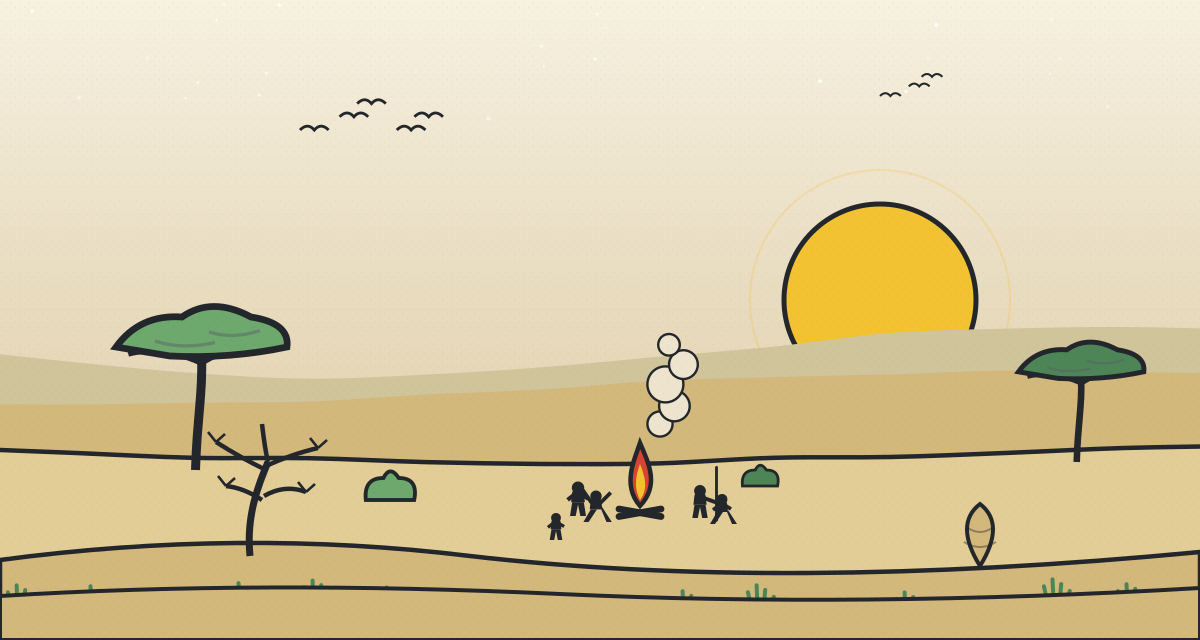
Out of Africa
Some three hundred thousand years ago, in what is now Morocco and East Africa, people anatomically like us were already knapping stone tools and controlling fire. Fire meant cooked food, and cooked food meant smaller guts and larger brains. Language — invisible to archaeology but betrayed by what followed — let bands of humans coordinate hunts, share knowledge, and remember the past out loud.
Beginning around 60,000 years ago, small groups walked out of Africa and into every habitable continent. They reached Australia by sea some 50,000 years ago, and the Americas, via the Bering land bridge, around 15,000 years ago. Every human alive today descends from those migrants.3 The cave paintings of Lascaux and Sulawesi, the carved lions and buried dead with red ochre, all whisper the same fact: these were symbolic minds, fully modern, living without cities, kings, or writing — and doing so for nearly all of human existence.
- c. 300,000 BCE Homo sapiens appears in Africa
- c. 50,000 BCE Humans reach Australia
- c. 15,000 BCE Humans reach the Americas
- c. 10,000 BCE Farming begins in the Fertile Crescent
- c. 7500 BCE Çatalhöyük flourishes in Anatolia
- c. 4000 BCE The plough and the wheel appear
The farming gamble
Around 10,000 BCE, in the hills of the Fertile Crescent, people began deliberately planting wild wheat and barley and penning wild sheep and goats. It looks like progress — and in the long run it was — but for the first farmers it was a gamble that paid off in toil. Skeletons from early farming villages show worse nutrition, shorter stature, and more disease than their hunter-gatherer neighbours. Farming fed more mouths per acre, so populations grew, but each mouth worked harder.
What farming bought, slowly, was surplus: more food than the growers needed right now. Surplus could feed potters, priests, and soldiers — people who grew no food at all. Villages grew into towns. At Çatalhöyük in Anatolia, thousands lived cheek by jowl in mud-brick houses entered through the roof, burying their dead beneath the floors, centuries before anyone dreamed of a king. Complexity, it turns out, did not begin with empires.4
Why this chapter matters
Everything after this chapter — cities, writing, empires, the device you are reading on — rests on the farming surplus. And the deep past sets the scale of the whole story: civilisation is roughly six thousand years old, a thin late chapter in a three-hundred-thousand-year book. Whenever later history feels inevitable, remember how long humans lived without any of it.